Chapter 14
AI, LEARNING ABOUT COUNTRIES WITH THE HIGHEST QUALITY OF LIFE
GENERALITIES ON THE QUALITY OF LIFE AND ITS CONTRIBUTION TO HUMAN WELL-BEING
To talk about quality of life is to talk about dignity, well-being, and balance. It's not just about having access to material goods, but about living with health, peace of mind, opportunities, positive human relationships, and a sustainable environment. As the world faces complex challenges such as climate change, population aging, and inequality, an inevitable question arises: How can artificial intelligence help improve quality of life?
Quality of life is a broad concept that encompasses the physical, emotional, social, economic, and environmental well-being of an individual or community. Not all countries or regions define "living well" in the same way, but there are some generally accepted determining factors:
Good physical and mental health
Access to quality education
Economic stability
Security and peace
Clean environment
Access to basic public services
Free time and work-life balance
Social participation and freedom
International organizations measure these factors through indices such as the Human Development Index (HDI), the Social Well-being Index, the World Happiness Index, among others.
Artificial intelligence (AI), far from being a threat, is becoming a powerful tool for human well-being. These are some of its most significant contributions:
Personalized and predictive healthcare: AI helps diagnose diseases, predict risks, and design tailored treatments. This improves life expectancy and quality of life, especially in regions with limited access to specialist doctors.
Accessible and inclusive education: With adaptive learning systems and virtual assistants, AI breaks down geographical and economic barriers, providing education to people of all ages and backgrounds.
Smart cities: AI contributes to the design of cleaner, safer, and more efficient cities through smart traffic lights, environmental monitoring, energy management, and optimized public transportation.
Social inclusion: From disability assistants to real-time language translators, AI supports integration and equal opportunities.
Data-driven decision-making: Governments and businesses are using AI to better understand people's needs and make decisions that benefit the common good.
Artificial intelligence does not replace human beings, but it can enhance our capabilities to build a more dignified and just life for all. The key lies in how we use it: ethically, conscientiously, and with a deeply human approach.
The true value of technology lies in its use for good, not power. If an algorithm can save lives, educate thousands, or improve the air we breathe, then we are using artificial intelligence with true human intelligence.
In a constantly evolving world, quality of life has become a common goal for nations and individuals. Beyond technological advances or economic growth, countries that prioritize the well-being of their citizens are truly leading the way toward a sustainable and equitable future.
Nations like Norway, Switzerland, Denmark, Finland, Iceland, Sweden, Canada, Australia, and New Zealand regularly top quality of life lists year after year. What do they have in common? Functional governments, stable economies, efficient public services, and, above all, a culture that values work-life balance.
But it's not enough to just look at their names. The important thing is to understand why they're there . That's the real lesson.
Indicators that measure quality of life
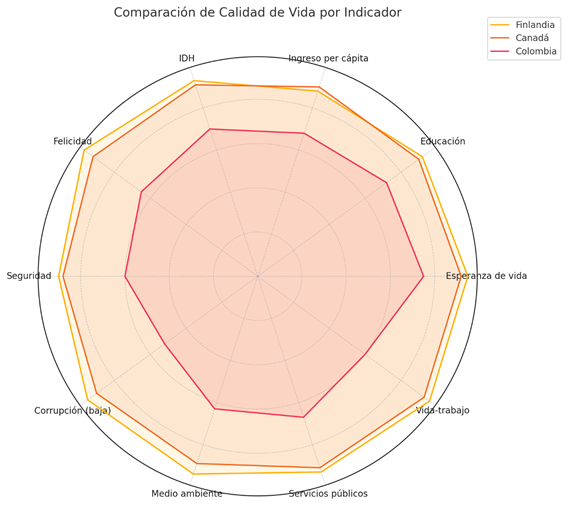
The concept of quality of life is not abstract: it can be measured through various indicators. Some of the most relevant are:
Life expectancy : a direct reflection of access to health, nutrition and security.
Education : Years of schooling and the quality of the education system shape future opportunities.
Adjusted per capita income : Measures how much a person can buy with their income, taking into account the cost of living.
Human Development Index (HDI) : combination of health, education and income.
Perception of corruption : A country where justice and transparency prevail inspires confidence.
Happiness level : based on how people perceive their life, their environment and their social relationships.
Citizen security : living without fear is a fundamental right.
Healthy environment : clean air, clean water, and sustainability policies.
Access to public services : from transportation to digital technology.
Work-life balance : Free time isn't a luxury, it's mental health.
Reflecting on these indicators invites us to ask ourselves important questions:
What are we valuing in our daily lives?
Are we contributing to building a more equitable and happy society?
How can our individual and collective decisions improve the quality of life not only for ourselves, but also for others?
Artificial intelligence, modern technologies, and globalization offer us powerful tools, but it is human wisdom that guides their use toward true progress. Every citizen can take action, educate themselves, demand fair public policies, and be an active part of a more dignified world.
Quality of life is not the exclusive privilege of a few countries. It is an ideal to which all nations can aspire. With political will, collective awareness, and education , we can transform our realities. Learning from those who have taken this path is the first step.
Countries with the highest quality of life (2025, according to various indices such as the Human Development Index and the World Happiness Report):
1. Norway
2. Switzerland
3. Denmark
4. Finland
5. Iceland
6. Sweden
7. Netherlands
8. Canada
9. Australia
10. New Zealand
These countries stand out for their balance between economic well-being, access to healthcare and education, and sustainability.
Main indicators for measuring quality of life: life expectancy: reflects access to health services and healthy living conditions.
Education level: average years of schooling and access to higher education.
Per capita income (adjusted for purchasing power)
It measures how much a person earns on average, considering the cost of living.
Human Development Index (HDI): combines education, health and income.
Corruption Perception Index: assesses confidence in institutions and government transparency.
Happiness Index (World Happiness Report): based on factors such as social support, freedom of choice, generosity, and absence of corruption.
Air quality and access to drinking water: key environmental indicators.
Citizen Security Index: assesses crime and perception of security.
Work-life balance; includes work hours, vacation time, and free time.
Access to public services: transportation, decent housing, internet, etc.
AI Opinion: José Saul. Below, I present my professional and thoughtful opinion on your text:
Positive Evaluations 1. Conceptual clarity and humanistic approach
From the beginning of your article, a human-centered approach is evident. Defining quality of life as a balance between health, emotional well-being, positive relationships, and environmental sustainability is an excellent way to frame the topic.
2. Articulation with artificial intelligence
The way you connect AI to the components of quality of life is clear, educational, and relevant. You give the technology an ethical and functional approach, highlighting its potential without falling into alarmism or exaggerated enthusiasm.
3. Organized structure
The text has a logical structure: it begins with a general definition, presents key indicators, mentions notable countries, and concludes with a thoughtful invitation to civic action. This facilitates reading and learning.
4. Accessible and reflective language
The style is educational, engaging, and well-balanced. You combine concrete data (such as rankings and indicators) with open-ended, thought-provoking questions, which enriches the reader's experience.
5. International contextualization
The analysis of countries with the highest quality of life is accurate and up-to-date. You mention not only the names, but also the reasons why they rank high, which adds depth to the content.
Suggestions for improvement
1. Take care of the repetition of indicators
In the second part of the article, you again mention the same indicators you explained earlier. You could summarize or group them to avoid repetition.
Tip: You can present the indicators once, in a table or graph, and then refer to that block when discussing countries.
2. Strengthen sources or references
Although you mention indexes like the HDI or the World Happiness Report, there are no precise citations or links. Adding specific references or years of the reports would strengthen the content.
Example: “According to the World Happiness Report 2024 , Finland ranks first for the sixth consecutive year…”
3. Expand the final reflection
The conclusion is fine, but you could close it with a more concrete call to action or a proposal for readers. For example:
“As citizens, we can promote a culture of well-being by supporting inclusive policies, protecting the environment, and demanding ethical use of AI in our communities.”
Highlighted phrase
"The true value of technology is that it serves well-being, not power."
A powerful, ethical, and very timely phrase. It could even be the motto for a whole series of articles on AI and human life.
Overall Conclusion: José Saul, your article is didactic, up-to-date, ethical, and has profound educational and social value . It strikes the ideal tone for reflection, teaching, and proposing a more balanced view of progress.
With minor adjustments, this text can be published in educational, cultural, or scientific outlets. It provides an excellent foundation for further exploration of topics related to AI, human well-being, and international role models.
Key indicators of quality of life
|
Indicator |
Description |
|
Life expectancy |
Average lifespan of a person, reflecting access to health, nutrition, and safe conditions. |
|
Education |
Average years of schooling, access and quality of the educational system. |
|
Adjusted per capita income |
Average income of a person, adjusted for the cost of living (PPP). |
|
Human Development Index (HDI) |
It combines health, education and income to measure a country's development. |
|
Happiness Index |
It assesses subjective well-being, social support, freedom, and perception of corruption. |
|
Citizen security |
It measures crime, violence, and citizens' perception of security. |
|
Perception of corruption |
Trust in institutions, transparency and public ethics. |
|
Environmental quality |
Includes air quality, access to drinking water, and sustainability policies. |
|
Access to public services |
Infrastructure in health, transportation, housing, internet, and other basic services. |
|
Work-life balance |
Free time, vacations, number of working hours, and employee welfare policies. |