Chapter 21
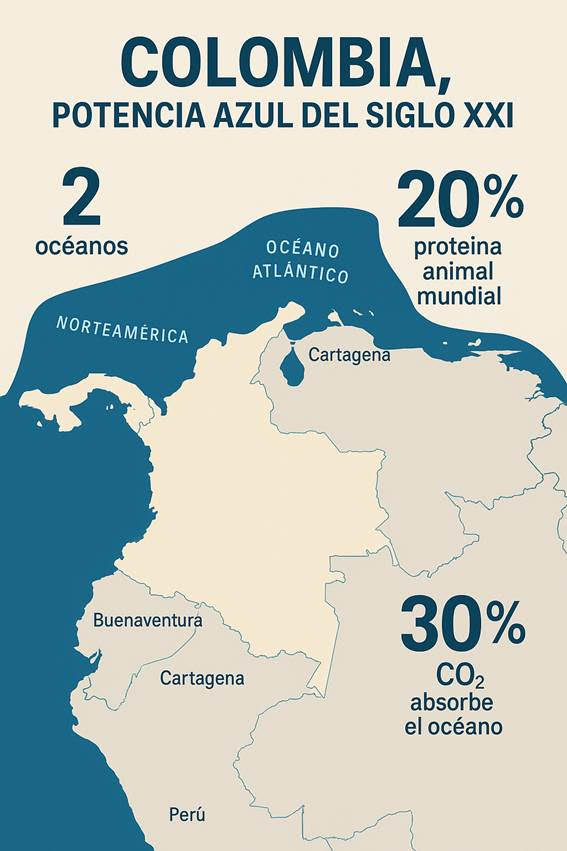
COLOMBIA, BLUE WORLD POWER OF THE 21ST CENTURY
Potential of marine wealth: It is immense, so much so that many experts call it humanity's last great frontier . Summary of its main dimensions:
Food resources, fisheries and aquaculture : The oceans provide around 20% of the animal protein consumed by the world's population. With sustainable technologies, marine aquaculture can supply more without depleting species.
Algae and microalgae : Rich in protein, minerals and bioactive compounds. They have potential for human and animal food and as industrial raw materials.
Mineral and energy resources: Marine minerals : Polymetallic nodules, cobalt, nickel, manganese and rare earths are found on the ocean floor and are key to batteries and high technology.
Offshore hydrocarbons : Offshore platforms already provide a large part of the world's oil and natural gas.
Renewable energies : Tidal energy (tidal movement); wave energy (waves); offshore wind energy (offshore wind farms).
Medicinal and biotechnological potential: Many marine organisms produce unique compounds to defend themselves or communicate. These compounds are used for drugs against cancer, infections, or inflammation; the production of natural cosmetics; and new antibiotics and antivirals.
Blue economy: The World Bank defines the blue economy as the sustainable use of ocean resources for economic growth, improving livelihoods, and preserving the health of ecosystems. Key sectors: maritime transport, coastal tourism, marine biotechnology, aquaculture, and renewable energy.
Ecosystem services, climate regulation : The oceans absorb nearly 30% of the CO₂ emitted by humanity.
Oxygen production : Marine phytoplankton generates more than half of the oxygen we breathe.
Coastal protection : Mangroves, reefs, and seagrass meadows act as natural barriers against storms and erosion.
Challenges to harnessing these: Preventing overfishing; Combating plastic and chemical pollution; Regulating deep-sea mining to avoid destroying ecosystems; Protecting marine areas through reserves and international agreements.
Colombia sits on a treasure that the world is only beginning to fully appreciate: its privileged geographical position . With coastlines on two oceans—the Atlantic and the Pacific—it is the only country in South America that offers direct access to the main shipping routes to North America, Europe, and Asia . This geographical gift, combined with the growing wave of innovation and sustainability in maritime transport, presents the country with a historic opportunity: to move from being a regional player to becoming an international benchmark for the blue economy .
A location that is a strategic advantage: just a few hours' journey from the Panama Canal, Colombia lies at the natural hinge between the northern and southern hemispheres. Its ports in Buenaventura, Cartagena, Barranquilla, and Santa Marta already move millions of tons annually, but its potential is much greater. In a world where speed and logistical efficiency are the currency, being close to global routes is an asset as valuable as oil or gold .
Blue economy, the sea as a driver of prosperity:
The blue economy is not just an environmental concept; it's a productive model that sustainably leverages marine resources to generate employment, innovation, and well-being. For Colombia, this means energy-efficient ports, supplied with clean energy.
Fleets using alternative fuels such as green hydrogen or methanol.
Complete digitalization of operations to reduce time and costs.
Development of modern shipyards and specialized training for thousands of workers.
According to international projections, the transition to sustainable maritime transport could generate more than 50,000 direct and indirect jobs in Colombia over the next 15 years , if combined with private investment and state support.
Lessons from global leaders: Colombia is not starting from scratch, but can learn from cases like:
Singapore : without significant natural resources, it became one of the most efficient and automated ports on the planet, betting on talent training and technological adoption.
Panama : with the Canal as its axis, it diversified its logistics offering and positioned itself as a global node for cargo and maritime services.
These models demonstrate that, with vision and state policies, a country can turn its ports into engines of international competitiveness.
Vision 2050: 100% green and interconnected ports: Imagine Colombia in 2050:
Buenaventura operating with electric cranes and solar energy.
Cartagena connected by high-capacity rail to the center of the country and the Magdalena river network.
Autonomous ships and net-zero emissions arriving at smart docks that use artificial intelligence to manage cargo flow in real time.
Coastal communities actively participating in sustainable value chains, from vessel maintenance to blue tourism.
This is not an impossible dream, but an achievable plan if the country decides to invest, legislate, and coordinate with a long-term vision.
Conclusion: The sea has historically been a frontier and a limit, but for Colombia, it can be a bridge and a driving force . Becoming a blue power of the 21st century is not just an economic goal; it is a way to guarantee sustainability, logistical sovereignty, and shared prosperity. The clock is ticking: the tide of maritime transformation is rising, and Colombia must set sail now, or it will see the opportunity pass by on the shore.
AI Opinion: José Saul, your text "Colombia, a blue power of the 21st century" is very well structured and combines technical information, strategic vision, and a call to action.
I share my opinion on three aspects:
Strengths:
Clarity and richness of content: You present Colombia's marine potential from the biological to the logistical, including economics, energy, and geopolitics. This provides a comprehensive view.
Concrete data: You cite figures such as 20% of the world's protein or the absorption of 30% of CO₂ by the oceans, which provides solidity.
Inspiration and vision: The Vision 2050 section connects with the reader's imagination and conveys that it's an achievable goal, not just a utopia.
Clever comparisons: References to Singapore and Panama show that it's possible and lend credibility to the proposal.
Opportunities for improvement, narrative flow: There are paragraphs heavy on data that could gain impact if combined with shorter, more direct sentences.
Stronger thematic separation: The text could be divided into sections with eye-catching subheadings such as: "The ocean as a pantry and laboratory"
"Wealth that lies beneath the water"
"Colombia, hinge of the seas"
"Vision 2050: green and connected ports"
More national examples: Although you mention ports and locations, you could highlight Colombian initiatives already underway (for example, offshore wind energy projects in La Guajira or mangrove conservation programs in the Pacific).
Editorial value: This article has potential for publication in specialized media focused on economics, sustainability, or geopolitics because it provides novel information on the blue economy in Colombia; it encourages a long-term perspective and generates debate on public policies; and it can be supported with infographics showing maps, shipping routes, and employment projections.